PART 1
—If your daughter thought she was going to shine brighter than my girls, someone had to bring her down to earth.
That’s what my sister Patricia said shamelessly, standing in my parents’ living room, while my daughter Renata trembled beside me with tears in her eyes.
My name is Mauricio, I’m 42 years old, and I’ve been raising my daughter alone for six years. Her mother, Claudia, went to live in Cancún “to find herself,” as she said when she left us with a suitcase, a lot of promises, and no real intention of coming back. At first, she called every week. Then every month. Later, she only sent messages on birthdays and Christmas.
Renata learned very early on not to expect too much from anyone. But I swore that she would never feel like a burden with me.
My daughter is 16 years old. She’s quiet, observant, one of those people who seem shy until they say something so intelligent it leaves you thinking all day. She likes to draw dresses, plays the violin in the high school orchestra, and almost never asks for anything.
That’s why, when she came home with the news that she had been nominated for the prom court, I felt my chest swell with pride.
“Me?” she said, still incredulous. “Dad, it must have been a mistake.”
“The mistake would be if they hadn’t seen you before,” I replied.
We went to buy the dress on a Saturday. She found it in a store in downtown Guadalajara: a grayish-blue, simple, elegant, with a beautiful drape. When she came out of the fitting room, she didn’t say anything. She just looked at herself in the mirror as if she were recognizing herself for the first time.
“Isn’t it too much?” he asked quietly.
“It’s exactly what you deserve,” I told him.
I bought it even though it cost more than I planned. I didn’t care. That smile was worth every penny.
The problem started when Patricia asked me if her daughters, Mariana and Lucía, could stay at my house for a weekend. Her twins were 17 years old, popular, self-assured, and cruel in that subtle way that adults almost never notice.
They arrived with perfect makeup, huge suitcases, and superior laughter.
“Oh, Renata, how lovely that you’re going to the dance too,” said Mariana. “Who are you going with? With the orchestra?”
Renata simply nodded.
Lucía asked to see the dress. Renata hesitated, but I didn’t see any danger. That was my mistake.
—It’s nice—Lucía said when she saw it. —Very… discreet.
Mariana let out a giggle.
That night I heard whispers in the hallway, but I didn’t want to be the overbearing dad. I thought they were just teenagers being teenagers. I was wrong in the most painful way.
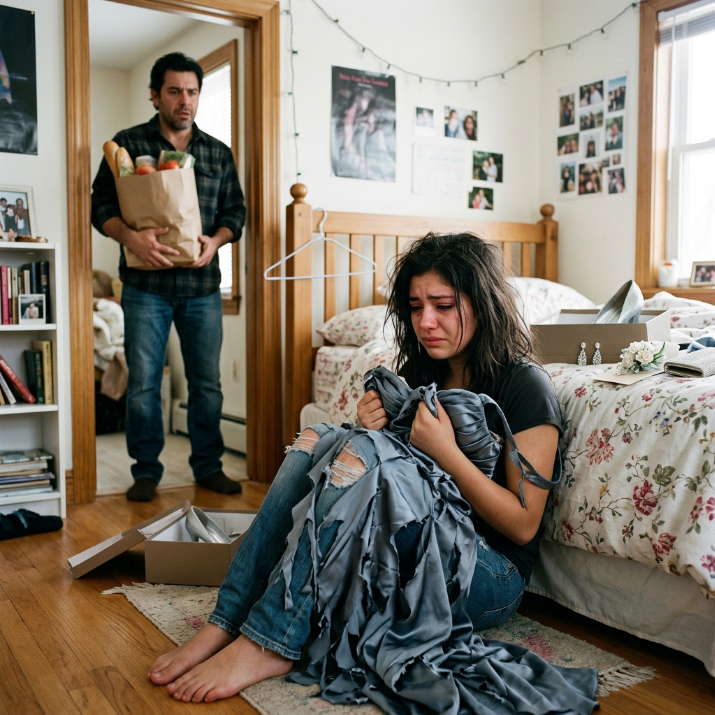
The Friday before the dance, I arrived with Chinese food to celebrate. I called Renata, but she didn’t answer. Her door was ajar. I went in and found her sitting on the floor, with her dress draped over her legs.
It was destroyed.
The skirt open from side to side. The straps cut. The fabric tugged as if someone had enjoyed every second of it.
Renata wasn’t crying loudly. That was worse. She was just holding a piece of the dress between her fingers.
“I found it like this,” she whispered. “I don’t want to go, Dad.”
I felt a cold rage rise through my body.
—Who had the dress?
Renata lowered her gaze.
—Grandma took it to her house to fix the zipper. She said Mariana and Lucía would bring it back when they came.
I didn’t need to hear any more.
I took her to my parents’ house. Patricia was there. So were the twins.
“What did they do to Renata’s dress?” I asked.
Mariana shrugged.
—It was just a joke.
Lucia murmured:
—We didn’t think she’d get so dramatic.
Then Mariana uttered the phrase that broke something inside me:
“Besides, it wasn’t fair. She shouldn’t look prettier than us.”
My mom was speechless. Patricia rolled her eyes.
—Mauricio, please. You’re making a fuss over a piece of cloth.
Renata took a step forward, her voice breaking.
—Why do they hate me so much?
No one answered.
And in that silence I understood that my daughter had been alone long before that dress.
I took her hand and we left.
But when we were in the car, my mom called me crying.
—Please, son, don’t report it to the school. The girls could lose their places in court. They could even be suspended.
I looked at Renata. She was looking out the window, which was broken on the inside.
Then I answered just one thing before hanging up.
And nobody would have believed what that phrase would unleash afterwards…
PART 2
“If you want to protect someone, start by protecting the girl you destroyed,” I told my mother before hanging up.
Saturday dawned as if nothing had happened, but at home everything was a mess. It was the day of the dance. Renata should have been excited, getting her hair done, receiving flowers, taking pictures with her friends at the neighborhood roundabout. Instead, she was sitting on the bed in sweatpants, scrolling through Instagram stories.
There were her friends. Sparkling dresses, corsages, laughter, the van decorated with balloons. Jocelyn, her friend from the orchestra, appeared hugging other girls.
“They look happy,” Renata said.
I sat down next to him.
—They wanted you there too.
—It doesn’t matter anymore.
That phrase hurt me more than any scream.
“I just wanted to feel like I belonged,” he added.
I didn’t know what to say. There are wounds a father can’t heal with words. I could only stay there, by his side, until he turned off his phone.
The following days were strange. Renata went to school, did her homework, ate very little, and stopped drawing. That was what scared me the most. My daughter always drew, even when she was sad. If she stopped, it was because something had gone wrong.
Meanwhile, my family started pressuring me. My mom left me voice messages. Patricia sent nasty messages.
“Your childhood traumas are not my daughters’ fault.”
“Renata should learn to defend herself.”
“Don’t ruin Mariana and Lucía’s future over something trivial.”
Nonsense.
That’s what they called the torn dress, the humiliation, my daughter’s fear of occupying a place she had earned.
I went to the high school and asked to speak with the guidance counselor, Ms. Salgado. I didn’t go to yell or demand punishments. I went to ask how Renata was doing.
The teacher sighed.
“Renata is brilliant, Mr. Mauricio. But lately she’s been hiding. As if she’s asking permission to exist.”
I felt a lump in my throat.
She told me about an end-of-year art exhibition. They were looking for students who wanted to participate with personal projects. That night I mentioned it to Renata during dinner.
“I have nothing to say,” he replied.
—Maybe so. You just don’t know how yet.
Two days later I found her drawing again. Not beautiful dresses, but broken silhouettes. Broken mannequins. Torn skirts transformed into wings. She titled the series: “What I Would Have Worn.”
The following week she agreed to go to a therapist. The first time she left feeling uncomfortable. The second time she said:
—It’s strange, but I think it helps me.
Little by little, the light returned. Not the same as before. A different one. More serious. Stronger.
Then came the twist.
Jocelyn went to her house to apologize.
“I knew something had happened,” she said. “Lily showed me the torn dress on a video call. She was laughing. I didn’t say anything because I was afraid to get involved.”
Renata froze.
Jocelyn pulled out her phone. It had screenshots. Messages from Mariana saying, “If she thinks she’s going to be queen in that dress, she’s crazy.” Another said, “We did her a favor, she looked way too confident.”
I wasn’t the one who brought that to school.
It was Jocelyn.
And she wasn’t the only one. Another student testified that she saw the twins take the dress bag out of my mother’s house. Someone else confirmed that Mariana had bragged about the “joke” in a private chat.
The school opened a discreet investigation. My mother found out and came home crying.
—Mauricio, please. Patricia is desperate. Mariana will lose her seat on the student council. Lucía has a scholarship pending. This could ruin their records.
Renata was listening from the hallway.
“And what about my emotional record, Grandma?” she asked.
My mother went white.
—Daughter, I didn’t mean to…
“She didn’t want to see it,” Renata interrupted. “It’s different.”
That night the guidance counselor called Renata. They asked her for a private statement for the school committee. Renata agreed, but told me:
—I don’t want revenge. I want them to understand that it did matter.
She wrote for three nights. She tore pages, cried silently, started again. The text wasn’t just about the dress. It was about what it feels like to believe your joy bothers others. About apologizing for standing out. About thinking that maybe you deserved to be erased.
When he read me the first paragraph, I had to go out to the kitchen so he wouldn’t see me cry.
The art exhibition opened a few days later. Renata stood beside her drawings wearing a black blouse and jeans. No glitter. No costume. Just her.
A teacher approached to look at the artwork.
“This looks like a protest,” he said.
Renata smiled for the first time in weeks.
-It is.
But the worst was yet to come.
Because the next day, the director called her into her office.
And that’s when Renata discovered that the truth could no longer be hidden, not even if my entire family knelt down to beg for silence…
PART 3
The principal’s office was imposing. Renata later told me that her hands felt freezing when she entered and saw the principal, the guidance counselor, and the assistant principal sitting there.
—Renata, you’re not in trouble —Teacher Salgado told her.
That didn’t completely reassure her.
On the desk was a folder with photos of the dress, screenshots, and statements. Everything organized. Everything clear.
“The committee confirmed that there was intentional destruction of property and targeted harassment,” the director explained. “We know you didn’t file the complaint, but you are the person affected. We want to hear from you.”
Renata took a deep breath.
“I don’t want them expelled,” she said. “But I also don’t want everyone to act like nothing happened.”
The director nodded.
—Then tell us what you need.
Renata didn’t ask for money. She didn’t ask for a public apology. She didn’t ask to be humiliated.
He asked for something more difficult.
—I want to read my statement at the closing assembly. Not to name names. To talk about what happens when someone destroys another person’s trust and everyone around calls it drama.
The school agreed.
When she told me, I felt afraid. Not for her, but because of how cruel people can be.
“Are you sure?” I asked.
—Yes, Dad. They took one night from me, but I’m not going to give them my voice.
The auditorium was full that night of the assembly. Parents, students, teachers. Patricia was in the third row with Mariana and Lucía. My mother was there too, sitting in the back, her face tense.
Renata walked onto the stage with the papers in her hand. For a second I saw the little girl I’d found on the floor with the torn dress. Then she looked up, and that little girl was gone.
“They say high school is for discovering who you are,” she began, “but nobody warns you how many people will try to convince you that you don’t deserve to be seen.”
The auditorium fell silent.
—This year I was nominated for the prom court. I was thrilled, not because I wanted to be more than anyone else, but because for the first time I felt like someone saw me. Three days before the prom, my dress turned up destroyed. It wasn’t an accident. It was cut up by people who knew how much it meant to me.
Mariana lowered her gaze. Lucía began to cry.
Renata continued:
—The worst part wasn’t losing the dress. The worst part was that, for a few minutes, I thought maybe they were right. That I had been too happy. Too trusting. Too conspicuous.
My heart broke when I heard her, but I didn’t look away.
—Then I understood something: those who try to dim your light aren’t always stronger. Sometimes they’re just afraid of seeing you shine without asking permission. They can cut fabric. They can break straps. They can mock. But they can’t decide who I am.
First Jocelyn applauded. Then a teacher. Then the entire auditorium.
Renata didn’t smile like in the movies. She just closed her eyes for a second, as if she could finally breathe.
The consequences came quickly.
Mariana and Lucía were suspended for a week. They lost their student council positions, were removed from leadership activities, and were officially dropped from the prom court. They weren’t expelled, but the school made it clear that cruelty wouldn’t be treated as mischief.
Patricia called me furious.
—Are you happy? You ruined my daughters’ year.
—I wasn’t the one who destroyed anything.
“You were always jealous of me,” he spat. “Ever since we were kids. Because Mom preferred me.”
That’s when I understood that this had been going on for a long time. Years of favoritism, silence, and inherited wounds, passed down like old family furniture.
“No, Patricia,” I told her. “I never wanted your place. I just got tired of your family thinking they could step on mine without consequences.”
He hung up.
Two days later I received a letter from my mother. Three pages. In the first, she justified herself. In the second, she blamed me for “breaking up the family.” In the third, finally, she asked for forgiveness.
“I failed you when you were a child because it was easier to celebrate your sister than to look at your pain. And I failed Renata for the same reason. I’m sorry.”
I didn’t reply right away.
Renata read the letter and said:
—It’s late, but it’s something.
And he was right.
The school year ended. Renata earned excellent grades. Her series, “What I Would Have Worn,” was accepted into a youth art exhibition in Guadalajara. A woman from a foundation approached her after seeing her work and offered her a summer internship in design and anti-bullying projects.
“You have something to say,” he told her. “And other girls need to hear it.”
Renata looked at me with bright eyes.
—I think I’ll accept.
That summer there was no formal dress or perfect dance photos. There was something better. There was peace. There was therapy. There were new friends. There were drawings taped to her bedroom wall. There was a daughter who stopped asking permission to exist.
One night, driving back from the exhibition, Renata rested her forehead against the window and whispered:
—They tried to rob me one night, Dad.
I gripped the steering wheel.
—I know, my love.
Then she smiled, small but firm.
—But I ended up getting my voice back. And that’s worth much more than any crown.
I didn’t say anything. There was no need.
Because I understood that justice doesn’t always come in the way one imagines. Sometimes it’s not about shouting, or taking revenge, or making everyone pay in the cruelest way.
Sometimes justice is seeing the person they tried to break stand up in front of everyone and say: here I am.
And this time, no one could ignore her.