Confirmed facts about the sinking of the MV Barima ferry in Guyana, the death toll, the rescue and the official investigation.
A post circulating on social media claims that a ferry “capsized minutes ago” without immediately revealing the location or providing a source. The most recent actual case involves the MV Barima , a state-owned vessel that sank off the Atlantic coast of Guyana.
The accident did not happen minutes ago. The emergency began on the night of Saturday, July 18, 2026, while the ferry was traveling from Georgetown to Port Kaituma. Authorities are continuing to update the situation and are working to recover the vessel.
Where did the MV Barima ferry capsize?
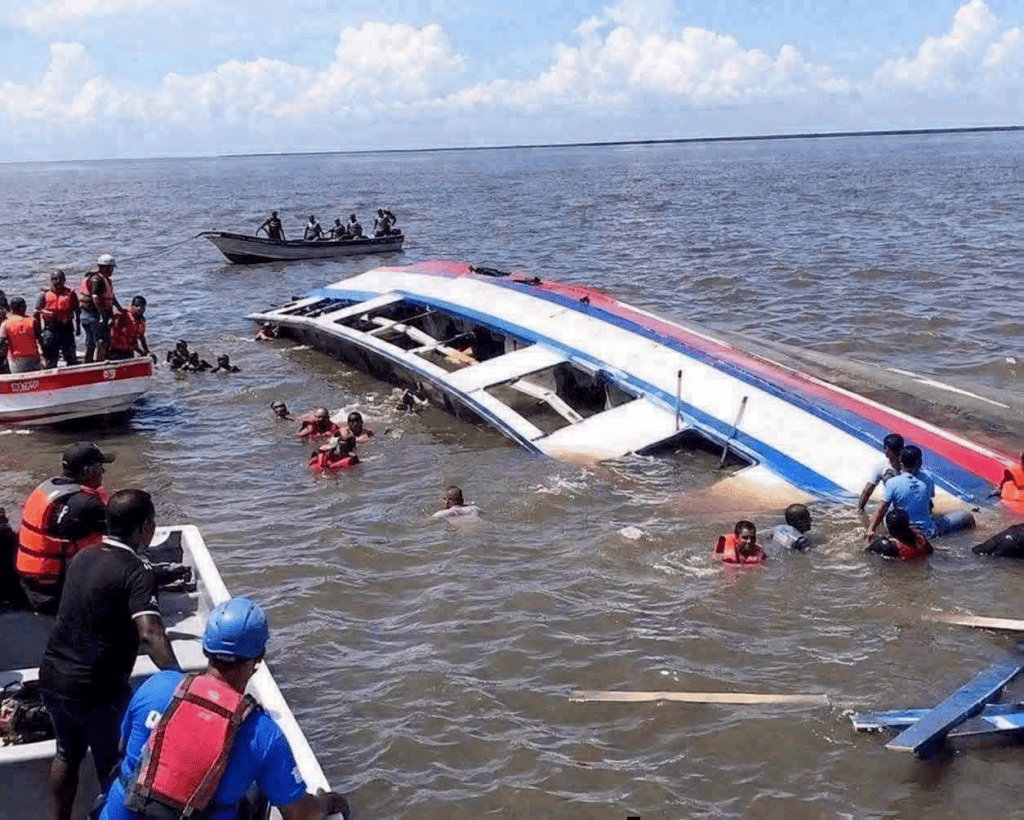
The MV Barima sank off the coast of Guyana, near the mouth of the Pomeroon River. The country’s Maritime Administration officially located the wreck about 13.8 nautical miles from the Anna Regina radio tower, in an area approximately ten meters deep.
The vessel had departed from Georgetown bound for Port Kaituma, a community located in the Barima-Waini region. The distress signal was received around 11:00 p.m., prompting the mobilization of the Guyana Coast Guard, aircraft, private vessels, and local fishermen.
Updated tally of victims and survivors
The Guyanese government reported on July 23 that the number of bodies recovered had risen to 72. The number of people rescued remained at 76 , while operations continued to locate those still missing.
Initial reports indicated that 133 people were on board, according to the official manifest. However, a review of recordings, testimonies, and other records established that there were possibly 179 people on board .
This discrepancy made it difficult from the outset to determine how many passengers were still missing. The figures may change as the ferry recovery operation, the identification of victims, and the verification of the complete passenger list continue.
How the accident happened
So far, authorities have not publicly established a definitive cause. Initial reports mentioned rough seas, but possible irregularities related to passenger registration, cargo handling, and compliance with safety procedures are also being investigated.
The initial manifest indicated that the ferry was carrying 116 passengers, 17 crew members, and approximately 268 tons of cargo. The government initially stated that the vessel was authorized to carry more than 300 passengers and had a cargo capacity of 284 tons.
However, the presence of individuals not included on the official list raised questions about the controls implemented before departure. Authorities have asked that no premature conclusions be drawn until an independent investigation determines what happened.
International search and recovery operation
The Guyana Coast Guard led the initial operation with support from the Defence Force, Maritime Administration, private companies, fishermen, and medical teams.
Later, specialists from the Brazilian Navy and the Trinidad and Tobago Coast Guard joined the effort. These teams contributed divers, technical expertise, and resources to work around the partially submerged ferry.
The recovery plan involves placing flotation bags around the vessel, lifting it, and towing it to shallower waters. This would allow for the inspection of interior areas that are difficult or dangerous for divers.
The operations also extended to the coast, mangroves and other areas where currents might have carried debris or people.
What is known about the ferry?
The MV Barima was a state-owned ferry built in 1939. It had undergone maintenance and dry dock work in 2024, and regularly made several monthly trips between Georgetown and Port Kaituma.
According to initial official information, the ship was carrying 250 life jackets, six inflatable rafts, and two rigid rafts. The investigation will have to determine whether this equipment was accessible, whether it functioned properly, and how the evacuation was organized during the shipwreck.
The age of a vessel does not, in itself, prove that it is unsafe. Its condition depends on maintenance, inspections, repairs, crew training, and compliance with navigation regulations.
Investigation and potential liabilities
The Government announced the creation of an independent Commission of Inquiry to examine all aspects of the disaster.
The points that will be evaluated include:
- The conditions of the vessel before setting sail.
- The actual passenger register.
- The distribution and weight of the load.
- Compliance with operating procedures.
- Crew preparation.
- The emergency response.
- The actions of the maritime authorities.
Prime Minister Mark Phillips stated that responsibilities will be established after the commission’s findings and recommendations are known.
Some of the personnel involved in maritime operations were placed on administrative leave while the investigations proceed.
For now, any claim that attributes the shipwreck solely to overcrowding, the weather, or a specific action by the crew should be considered preliminary.
Support for survivors and families
Authorities set up information and assistance centers in Georgetown, Port Kaituma, and Mabaruma. They also mobilized social workers, psychologists, and specialists in providing care to people affected by loss and traumatic situations.
The Government has offered transport, temporary accommodation, financial assistance and coverage of funeral expenses for the families of the victims.
Some family members were flown to Suddie Hospital to help identify the recovered bodies.
Guyana declared three days of national mourning, from July 22 to 24, with flags flown at half-mast.
Why it shouldn’t be shared as “breaking news” without verification
The headline “minutes ago ferry capsized in waters of…” omits the location, date, and source to entice the reader to open the publication.
That formula can continue to circulate for several days after the accident and create the impression that it is a new emergency.
Before sharing similar news, it’s advisable to check:
- The exact date of publication and of the accident.
- The name of the vessel.
- The country and the location.
- The original source of the figures.
- If the balance has been updated.
- Whether the cause is confirmed or remains under investigation.
Old photographs of other shipwrecks should also be avoided. A striking image does not prove that it corresponds to the event described.
Difference between capsizing, sinking and grounding
A ferry capsizes when it loses stability and tilts until it is on its side or upside down. It may remain partially visible or end up completely submerged.
Sinking occurs when enough water enters the vessel to cause it to descend below the surface. In the case of the MV Barima, authorities have used both terms because the ferry capsized and subsequently sank.
Grounding is different: it happens when the vessel gets stuck on the bottom, a sandbar, rocks or a shallow area without necessarily capsizing.
Safety recommendations for ferry passengers
Before starting a sea voyage, it is advisable to identify where the life jackets, exits and meeting points are located.
Adults should check that children have a vest that fits them properly.
During an emergency, you must follow the crew’s instructions, avoid going back for luggage, and not jump into the water unless necessary or instructed to do so.
It is also important to inform another person about the route, the name of the vessel, and the estimated time of arrival, especially on long or nighttime journeys.
Conclusion
The sinking of the MV Barima off the coast of Guyana is a confirmed fact, but it didn’t happen “minutes ago.” The vessel capsized during the night of July 18, 2026, while traveling from Georgetown to Port Kaituma.
As of July 24, the official tally indicated 72 bodies recovered and 76 people rescued. Authorities estimate there were approximately 179 people on board and are continuing efforts to locate those still missing.
The definitive cause has not yet been established. An independent commission will investigate the sailing conditions, passenger list, cargo, safety procedures, and emergency response.
Frequently Asked Questions
In which country did the MV Barima ferry capsize?
The accident occurred off the Atlantic coast of Guyana, near the mouth of the Pomeroon River.
When did the shipwreck occur?
The ferry capsized during the night of Saturday, July 18, 2026. Search and recovery operations continued on July 24.
How many people were traveling on the ferry?
The initial manifest listed 133 people, but subsequent investigation established that there were probably about 179 on board.
How many people were rescued?
The latest official tally consulted maintained the number of rescued passengers and crew at 76.
Is the cause of the accident known yet?
No. The definitive cause is still under investigation. The government announced an independent commission to determine what happened and establish responsibility.
Is the search still ongoing?
Yes. Teams from Guyana, Brazil, and Trinidad and Tobago are participating in the search, victim recovery, and efforts to raise the vessel.
Suggested internal links
- How to check if a viral news story is true
- Safety measures you should know before traveling by ferry
- What to do during an emergency at sea
Recommended image
Main image idea: Maritime rescue teams working near the partially submerged MV Barima, without showing victims or sensitive scenes.
ALT text: Rescue operation following the sinking of the MV Barima ferry off the coast of Guyana.
Use your own photograph, an image officially supplied by the authorities, or content from an agency or image bank with a verified publication license.
Editorial and liability notice
The numbers of victims, survivors, and missing persons may change as operations and official identification continue.
This article uses data available up to July 24, 2026 and avoids attributing a definitive cause while the investigation remains open.