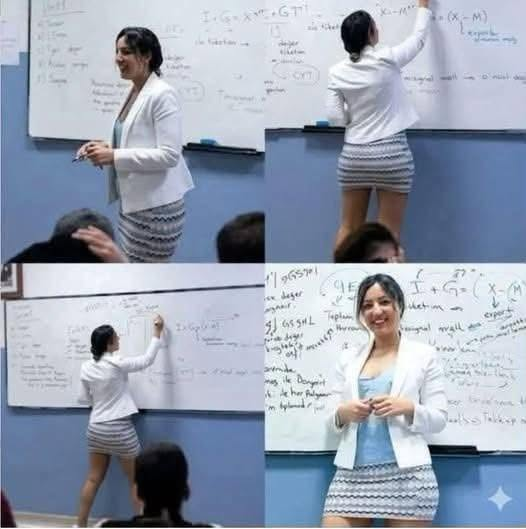
A New Jersey teacher was criticized for her clothing, but she wasn’t fired. Find out what really happened and why the story went viral.
The story of the supposedly expelled teacher

A headline has resurfaced on social media claiming that a teacher was expelled for attending classes in clothing considered “too sexy” and distracting her students.
The publication does not mention her name, the school, the date, or the official decision that supposedly ended her employment. This lack of information has allowed an old controversy to be presented as a recent expulsion.
The headline appears to refer to the case of Roxsana Diaz, an art teacher at an elementary school in Pennsauken, New Jersey. Her photos went viral in 2022 because she was seen teaching in tight-fitting clothing.
Although several websites claimed that parents were demanding her dismissal, there is no evidence that the teacher was expelled. Diaz publicly stated that she continued working and that many mothers in the school community supported her.
Who is the teacher who appears in the photographs?
Roxsana Diaz is an educator and artist known on social media as Toyboxdollz. She worked as an art teacher with young children and shared pictures of their school activities and art projects.
The photos that sparked the controversy were not new when they began circulating widely. Diaz explained that some had been published for over a year before national websites and viral accounts retrieved them in August 2022.
In the photos, she wore dresses, pants, and other garments that followed her natural body shape. The criticism wasn’t focused on any action against the students, but primarily on her appearance and how the clothes fit her.
Did the school really fire her?
No. Sources consulted indicate that the teacher kept her job.
In a broadcast aired in August 2022, Diaz stated that she was still a teacher and continued working. She also noted that the mothers in the school community were among her main supporters.
During a subsequent interview on Tamron Hall’s program, she explained that her supervisors were aware of the controversy but did not consider her attire grounds for dismissal. The teacher asserted that she had been with the school for years and did not wear inappropriate clothing in the classroom.
Therefore, the headline “teacher expelled” transforms the requests and comments of internet users into a labor decision that did not happen.
Were the parents really the ones who asked for her to be fired?
Several media outlets reported that some parents felt the teacher’s appearance could be distracting to students. Telemundo covered the controversy in June 2022 as a request for the teacher’s dismissal from a New Jersey school.
However, the teacher herself said that her experience with the families was different and that many mothers supported her.
Jolea Ardnt, the mother who took one of the photos that later went viral, appeared on Tamron Hall’s show and defended the teacher. She explained that she took the picture because she valued the teacher’s work with the children, not to create controversy.
This shows that one cannot speak of “the parents” as if all families had maintained the same position.
Why the word “sexy” is misleading
Describing a teacher as “sexy” is an interpretation made by those who view the photographs. It is not a professional category nor a specific offense.
A person can have a striking figure and, at the same time, wear clothes that cover their body and comply with the rules of their job.
The discussion should focus on verifiable facts: whether a dress code existed, what rules it established, and whether the teacher violated them. Evaluating only her body shape can turn a clothing policy into a judgment about her physical appearance.
Diaz maintained that her manner of dress was appropriate and that she would not have kept the position for years if she had been violating school policies.
The students were young children.
Some publications suggested that the teacher distracted her students. However, Diaz primarily worked with preschool and elementary school children.
The teacher stated that her youngest students did not interpret their bodies in the sexualized way suggested by adults on social media. She also indicated that attention should be directed toward their academic performance and educational projects.
There is no verifiable information to show that the students stopped learning, exhibited behavioral problems, or made complaints because of their clothing.
Claiming that a person is “distracting” solely because of their natural body shape can shift the responsibility for the interpretations of others onto them.
Can a school establish a dress code?
Yes. Educational institutions and other employers may establish reasonable rules of personal appearance and dress for their employees.
These policies may require professional attire, safety footwear, or appropriate clothing for specific activities. In the case of an art teacher, there might also be rules related to materials, movement, and safety within the classroom.
The U.S. Equal Employment Opportunity Commission explains that dress codes can be applied as long as they are not used to unlawfully discriminate and their requirements are comparable and consistently enforced.
New Jersey law also allows for reasonable standards of appearance, grooming, and dress to be required, as long as they do not violate other legal protections.
That means an institution can apply its rules, but it should do so based on specific clothing or behavior, not simply on an employee’s build.
The difference between tight clothing and inappropriate behavior
A tight-fitting garment does not prove that a person has behaved inappropriately towards their students.
To professionally evaluate a teacher, elements such as their performance, respectful treatment, student safety, compliance with policies, and quality of teaching should be considered.
The sources consulted do not attribute any inappropriate conduct with minors to Diaz. The controversy was related to photographs, comments about her body, and opinions about her clothing.
Mixing those criticisms with insinuations about his behavior towards students can generate serious accusations without any proof.
The impact of comments about the body
The criticism of Diaz wasn’t limited to debating a dress code. Some people told her to drop out of school and look for jobs related to her appearance.
The teacher explained that she initially took the virality with humor, but that the situation became worrying when the comments began to degrade her and present her body as a problem.
A person cannot easily alter their body structure to conform to the expectations of others. The same garment can be perceived differently depending on the wearer’s body.
Workplace discussions should avoid humiliation, insults, and comparisons that are unrelated to professional ability.
The importance of separating private life from work
Teachers also have the right to a personal life and the use of social networks, although they must respect the policies of their institution and protect the privacy of students.
Posting personal photos outside of work hours does not automatically constitute professional misconduct. The assessment changes when the content reveals confidential information, shows students without authorization, or contradicts specific job duties.
In this case, the controversy centered primarily on Diaz’s appearance inside and outside the classroom. No evidence was presented that he had exposed his students’ private information or made any dangerous posts.
How to verify similar stories
First, you must find the person’s name and the original date of the news.
Next, it’s worth checking whether the headline says she was fired or just that some people asked for her to be fired. These are very different situations.
A statement from the institution, the person involved, or a reliable local source should also be located.
Posts that end with “see more” often omit the outcome. In this case, many repeated for years that the teacher had been expelled, even though she had publicly confirmed that she was still working.
What not to automatically believe
The teacher was not expelled according to available information.
There is no evidence that his students stopped concentrating because of his appearance.
The mother who took the viral photograph defended her work.
Not all families requested his removal.
Wearing tight clothing does not confirm inappropriate behavior.
The viral discussion began in 2022 and does not correspond to a recent expulsion.
A publication repeated by many pages does not automatically become true news.