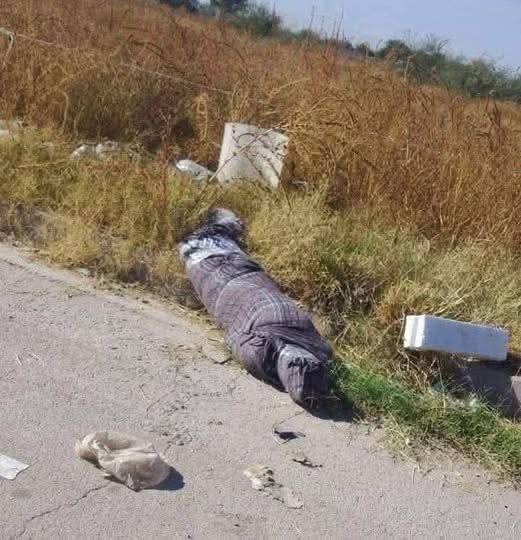
In the early hours of the morning, as the city slowly awoke, the residents of a quiet neighborhood made a discovery that disrupted the rhythm of daily life. What began as a routine dawn quickly turned into a moment of collective unease, reminding everyone how fragile the feeling of security can be.

Realizing it wasn’t ordinary trash, he stepped back in shock and immediately sought help. Within minutes, local authorities were notified.
A swift response from the authorities.
Police arrived quickly and secured the area, blocking access to the vacant lot. Emergency vehicles soon arrived, their flashing lights drawing the attention of nearby houses, as residents came out to see what had happened.
Authorities worked methodically, attending to the scene with caution and professionalism. The area was cordoned off to preserve evidence, and residents were asked to keep their distance while investigators assessed the situation.
Although authorities did not immediately release specific details, they confirmed that a person had been found dead and that the case would be handled as a serious criminal investigation.
A community watches in silence.
Differences Between a Police Officer and a Detective Career | Goodwin University
As the morning wore on, the news spread quickly through the neighborhood. People gathered at a distance, speaking in hushed tones, speculating quietly, and trying to comprehend what had happened so close to their homes.
For many, the shock stemmed not only from the discovery itself but from the realization that such an event could occur unnoticed in a familiar setting. Parents hugged their children. Shop owners paused their routines. Conversations shifted from everyday concerns to questions about safety and uncertainty.
The atmosphere was heavy, marked by a shared sense of disbelief.
The work of the investigators.
Specialized investigation teams arrived later that morning to thoroughly examine the scene. Their goal was to gather information that would allow them to identify the individual and determine the circumstances of his death.
Authorities emphasized that no premature conclusions would be drawn. Every step would be guided by evidence, forensic analysis, and established legal procedures.
The individual had not yet been identified, and authorities asked for the public’s patience while the investigation continued.
Rumors versus reality.
As is often the case in times of uncertainty, rumors began to circulate. Some residents speculated about possible motives, while others shared theories based on incomplete information. Social media amplified these discussions, spreading snippets of speculation far beyond the neighborhood itself.
Local authorities urged the public to avoid jumping to conclusions or sharing unverified claims. They emphasized that speculation could hinder the investigation and cause unnecessary distress to families who might already be suffering.
The message was clear: the facts would emerge in time, and accuracy mattered more than speed.
The broader social context.
Port Moody Police Department –
Incidents like this don’t happen in isolation. They reflect deeper societal challenges, such as economic inequality, limited access to resources, and deficiencies in community infrastructure. Vacant lots, poorly lit streets, and neglected public spaces can become symbols of broader neglect.
While the investigation focused on the immediate facts of the case, many residents began to question how their neighborhood had reached a point where such spaces existed without oversight or care.
The discovery became a catalyst for conversations about accountability—not just individual responsibility, but collective action.
The human cost behind the headlines.
Beyond the police reports and media coverage lies a simple truth: a human life was lost. Regardless of the circumstances, the person found that morning was someone’s child, perhaps a parent, a sibling, or a friend.
This realization weighed heavily on the community. The incident was no longer just news; it was a reminder of our shared humanity and the silent suffering that can exist beneath the surface of everyday life.
Many residents expressed concern for the family who would eventually receive the news, acknowledging that grief often unfolds away from the public eye.
The importance of responsible reporting.
Local journalists covering the story faced a difficult balance: informing the public without sensationalizing the tragedy. Responsible reporting focused on confirmed facts, official statements, and the broader implications for community safety.
Both authorities and the media emphasized the importance of avoiding graphic descriptions or inflammatory language. The goal was to inform, not to shock or instill fear.
This approach helped keep the focus on solutions rather than spectacle.
Community response and reflection.
In the days following the discovery, neighborhood leaders began discussing ways to improve safety and communication. Suggestions included better lighting, community patrols, and increased coordination with local services.
Residents expressed their desire to reclaim abandoned spaces and transform them into areas that foster connection rather than fear. The incident served as a wake-up call, highlighting the need for long-term investment in community well-being.
Moving forward with caution and care.
While the investigation continues, authorities have stated that updates will be provided as appropriate. They have encouraged anyone with relevant information to come forward and have assured the public that the case is being handled with seriousness and respect.
For now, the neighborhood remains vigilant, united by a shared determination to look out for one another while we await answers.
A reminder we cannot ignore.
This incident is not defined by sensational headlines or dramatic language. It is defined by loss, uncertainty, and the urgent need for reflection.
It reminds us that safety is not guaranteed by familiarity, that silence can mask serious problems, and that communities must remain engaged, informed, and compassionate.
As the city moves forward, the hope is that understanding, accountability, and collective responsibility will prevent these tragedies from becoming commonplace.